Twelve inches. That's the depth that separates a stone wall still standing in fifteen years from one leaning like a drunk at closing time. Ask most homeowners what makes stone landscaping work and you'll hear about color palettes and rustic charm. Nobody mentions the burial depth of the first course, the gravel behind the wall, or why three shrubs in a straight row look wrong while three in a triangle look like they belong.
I learned that the expensive way. A retaining wall on my own front slope looked sharp for one season, then bowed outward the following spring. The problem wasn't the stone. It was the sixteen bags of gravel I'd skipped because my back hurt and the wall "wasn't that tall." If you want to improve curb appeal with stone landscaping and have it still look right years later, you need the geometry rules and the sub-base rules, not just a Pinterest board.
Key Takeaways
- Odd numbers of plants (3, 5, 7) read as natural; even numbers read as installed.
- A retaining wall needs roughly a third of its height buried below grade, plus a gravel and drainage layer behind it.
- Gravel mulch at 5–10 cm depth suppresses weeds and survives wind better than bark chip.
- Stone entry steps and a clear path generate the biggest first-impression gain per dollar.
- Flat stone on flat ground looks dull; vary height, texture, and orientation.
Why stone works harder than mulch for curb appeal
Walk up to any house and your eye lands on two things: the path your feet want to take and the line where the ground meets the front wall. Both are stone problems. A mulch bed settles, blows into the street after a storm, and needs topping up every spring. Stone doesn't. It stays put, sheds water, and gives the front of a house a deliberate edge that bark simply cannot fake.
Real talk: stone costs more upfront. A pallet of flagstone for a walkway runs several times what a few bags of cedar mulch would. But the maintenance equation flips within a couple of seasons, because stone doesn't decompose, doesn't need annual re-spreading, and doesn't harbor the same weed pressure when it's laid properly over fabric.
The role of texture and color
Stone gives you something plants can't: a permanent gray, tan, or buff baseline that your greenery sits against. Think of it as the neutral wall in a room where the furniture changes every season. If your house is warm-toned brick, cool gray granite will fight it. Buff limestone or fieldstone tends to settle in beside red brick without argument.
Placement matters as much as the choice. A single stone feature — a wide entry step, a low garden wall — reads as intentional. The same stone spread thin across five scattered spots reads as random.
Drainage you didn't know you needed
Water is the reason most stone installations fail. A paved walkway pitched flat holds puddles. A retaining wall without a gravel backfill pushes water through the face and freezes. When you plan any stone work, plan the water path first. Slope paths away from the foundation at about 2 percent, and treat every wall as a drainage structure that happens to hold soil back.
What is the 3-5-7 rule in landscaping?
The 3-5-7 rule is a planting guideline: group plants in odd numbers — three, five, or seven specimens of a given type — arranged so they read as a cluster rather than a lineup. Odd numbers create asymmetry, and asymmetry is what makes a planting look like it grew there rather than got installed.

Here's the part people miss. The numbers aren't the rule. The relationship between the numbers is. In a proper 3-5-7 grouping, the tallest element sits off-center, the middle-height plants cluster to one side, and the lowest plants fill the gaps and spill forward. You're building a triangle in plan view and a triangle in elevation at the same time.
How to apply odd-number grouping with stone
Stone gives you the easiest way to cheat on this rule. A boulder counts as a plant element. So does a stone bench, a bird bath, or a mound of gravel.
- Three boulders of graduated sizes, none in a straight line
- Five low stone steppers, unevenly spaced so the eye has to work slightly
- Seven shrubs — but three of one species, two of another, and two of a third; the number is the total, not the species
- A single tall ornamental grass as the "7" against two medium shrubs as the "5"
I once planted three identical boxwoods perfectly equidistant along a low stone wall. It looked like a chessboard. I moved one twelve inches forward and to the left, and suddenly the bed looked natural. Same plants, same stone, different geometry.
What is the 1/3 rule for retaining walls?
The 1/3 rule for retaining walls means the buried portion of the wall should equal roughly a third of the exposed height. A wall standing 60 cm above grade needs about 20 cm below grade, sitting on compacted base and a proper footing. That buried third resists the lateral load pushing the wall outward from the soil behind it.
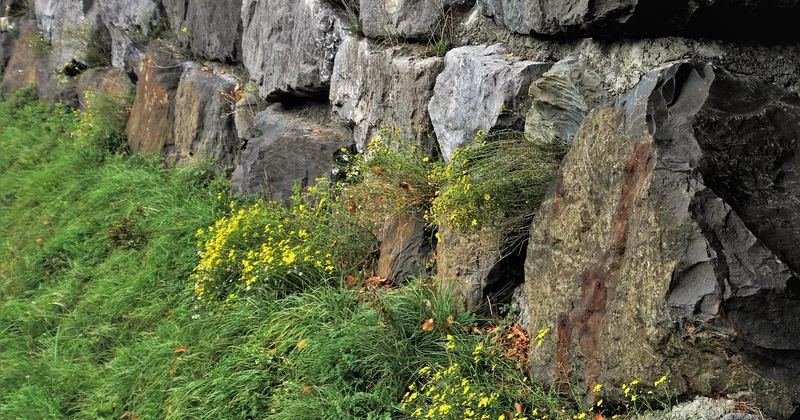
Two other details belong to the same rulebook. First, the wall should lean slightly back into the slope — a batter of about 1 inch per foot of height. Second, the soil behind the wall needs a gravel drainage column wrapped in geotextile fabric, with a perforated drain pipe at the base. Skip any of these and the wall will eventually tell you about it, usually after a wet winter.
A wall that failed — and what fixed it
That bowed wall on my slope? Here's what I did wrong:
- I set the base course on loose soil instead of compacted gravel.
- The base stones were buried less than a third of their height.
- No drainage column behind the wall — just soil packed tight against the stone.
- No fabric separating soil from drainage stone.
I rebuilt it with a compacted 10 cm gravel footing, buried the base course roughly a third of the way, and packed a 15 cm column of clean gravel behind the wall with fabric on both sides. It's held for several freeze-thaw cycles since. Total do-over cost me about twice what a proper first build would have. The lesson lands hard.
What are some landscaping ideas to improve curb appeal?
Focus on the first 20 feet. That's the zone from the sidewalk to your front door, and it's where a visitor's judgment forms. Stone does the most work here, because it sets the visual rhythm that plants fill in.
Stone entry steps and landings
Wide stone steps with a landing at the top change the entire face of a house. Aim for a tread depth of at least 30 cm and a rise under 18 cm — anything steeper and guests feel like they're climbing. A stone landing about 1.2 m deep gives the eye a place to rest before the front door.
Stone-edged beds and walkways
A clean stone edge does more for a front bed than flowers will. Set brick or cut stone edging on a compacted base, buried flush with the turf so the mower glides over. Flagstone walkways with a creeping thyme or moss joint feel softer than concrete and read as part of the landscape.
Stone accent boulders and outcroppings
Bury boulders a third of their height — same instinct as a retaining wall. A rock sitting on the surface looks placed. A rock half-swallowed by soil looks found. Cluster in odd numbers and vary the sizes so the group reads as one feature.
What actually enhances curb appeal?
Of everything on this list, three moves give you the strongest return for the money and effort:
- A clear, well-pitched stone path from sidewalk to door. No obstacles, no puddles, no side-stepping.
- A stone entry treatment — steps or a landing — that signals the front door is intentional.
- Consistent edging between beds and lawn, so the boundary is crisp from the street.
Recent paint, clean gutters, and a visible front door number matter too, but they're outside the stone column. What I'll defend to the end is that stone gives you permanent lift — it doesn't yellow in August, doesn't need replacing, and doesn't hide your house behind overgrown shrubs.
Comparing stone options by curb-appeal impact
| Stone element | Best placement | Typical material | Curb-appeal lift | Effort |
|---|---|---|---|---|
| Stone entry steps | Front door approach | Bluestone, granite, cut limestone | Very high | High |
| Flagstone walkway | Sidewalk to door | Irregular flagstone, steppers | High | Medium |
| Low garden wall | Bed boundary or slope | Fieldstone, cast stone block | High | Medium |
| Gravel mulch | Beds and foundation strip | Pea gravel, crushed granite | Moderate | Low |
| Accent boulders | Island beds, corners | Local boulder stone | Moderate | Low |
Gravel depth, stone size, and the details that get skipped
Gravel isn't just decoration — it's a functional layer. For a path or a bed, spread crushed stone to a depth of 5 to 10 cm over a compacted base and a woven geotextile fabric. Too thin and the soil shows through after the first rain. Too thick and the stone shifts underfoot like walking on marbles.
Stone size dictates function. Anything under 1 cm is decorative dust. Between 1 and 3 cm suits walking surfaces. Above that you're into boulder territory and need a footing, not a bed. Use larger grades along drainage swales so water can move freely through the gaps instead of pooling.
How to maintain stone work over the years
Stone asks for almost nothing once it's set right. What it does need:
- Refreshing the gravel top-up every three to four years as it compacts
- Pulling weeds that sprout in joints before they seed
- Checking wall slopes yearly for any lean, especially after ground thaws
- Re-seating loose steppers so they don't become a trip hazard
If you're using stone veneer rather than solid stone, seal it once every five to seven years to slow moisture absorption. Solid stone needs nothing but a rinse.
The line that actually matters
Stone landscaping works when it hides its own engineering. A wall with the right buried third doesn't look engineered — it looks inevitable. A cluster of three boulders looks like nature, not like a delivery. The best compliment a stone installation gets is silence: no one comments on it, because it belongs to the house. That's the target. Pick one element — the entry steps or the path — do it right the first time, and let the odd-number groupings and gravel depths stay where they belong: under the surface, doing the work nobody sees.