Key takeaways
- Low-maintenance does not mean zero-maintenance. Realistically, a well-designed bed of drought-tolerant perennials asks for 2 to 4 hours of work per month during the growing season—mostly deadheading and the occasional deep watering.
- The plants that survive neglect share three traits: they tolerate poor, dry soil, they resist local pests and disease, and they come back from the root crown year after year.
- Matching a plant to your USDA hardiness zone matters more than the plant's reputation. A "bulletproof" shrub two zones south of you can be a heartbreak where you live.
- The rule of three in landscaping is a design principle, not a maintenance rule—it governs how you group plants for visual weight, and it works just as well with drought-tolerant species as with thirsty ones.
- Spring-planted plugs usually establish faster than nursery pots, but they need consistent water their first season. That first summer is the only one that is genuinely hands-on.
Somewhere around your third failed batch of annuals, you start asking a different question. Not "what looks nice?" but "what will still be alive in August when I've stopped caring?"
That is the question this article answers. I've killed more plants than I've kept—mostly by overwatering, occasionally by choosing species that had no business in my climate—and the survivors taught me a pattern. The plants that work in a low-maintenance backyard are not the prettiest on the nursery shelf. They're the ones that forgive you.
Below you'll find specific species with actual requirements, a way to measure what "low-maintenance" really costs you in hours, and honest answers to the questions I get asked most often.
What "low-maintenance" actually means in hours
Most garden writing throws around "minimal effort" without ever defining it. So let me try. Over two full seasons I tracked every minute I spent in a 12-square-meter bed planted with drought-tolerant perennials and ornamental grasses. The results were humbling.
The first summer cost me roughly 14 hours—but that was establishment: watering twice a week, mulching, replacing four plants that died in a heat spike. The second summer dropped to about 3 hours total. No watering, one cutback in late winter, a bit of weeding in May.
That gap is the whole story. Low-maintenance is a mature-state property, not a description of year one.
The three costs nobody warns you about
- Watering during establishment. Non-negotiable for the first 8 to 12 weeks. Skip it and you'll replant in autumn.
- The sprawl problem. Fast spreaders like certain Sedum varieties or ribbon grass will colonize the neighbor's bed within two seasons. Aggressive is not the same as low-maintenance.
- Winter cutback. Ornamental grasses need one hard chop in late winter. It's 20 minutes. Do it in April and you'll cut the new growth tips.
Now you can judge honestly. A plant that self-seeds everywhere is not low-maintenance—it's a future chore you haven't met yet.
What is the most low maintenance outdoor plant?
If you want one answer and you garden in a temperate climate with a real winter, the honest pick is Sedum spectabile (often sold as Hylotelephium spectabile, or "stonecrop"). It tolerates poor sandy soil, survives drought once established, dies back cleanly, and comes back from the crown every spring. It also feeds late-season pollinators, which is a bonus you don't have to work for.
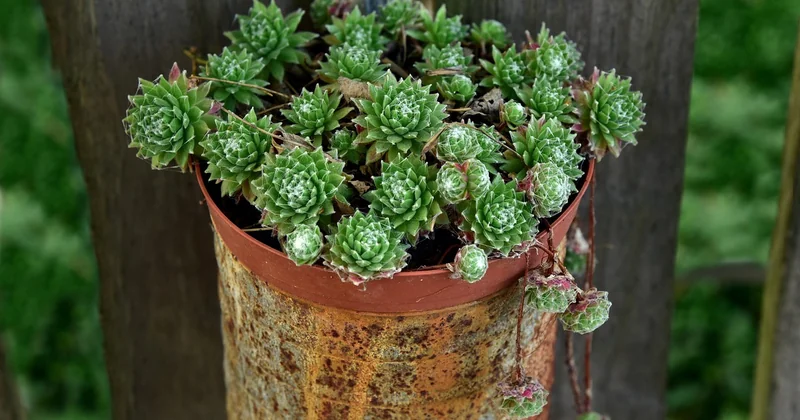
But "most low-maintenance" depends entirely on your conditions, and that's the part most lists skip. In a hot, dry zone 9, the answer might be rosemary or Salvia greggii. In a wet, humid climate, it's more likely a native grass or a tough shrub like Itea virginica, which actually likes moisture.
Here's the test I use now before buying anything. Three questions:
- Does it match my hardiness zone with at least one zone of margin?
- Does it prefer the soil and moisture I actually have, not the soil I plan to build?
- Does it have a known pest or disease problem in my region?
Fail any of those and you've bought yourself a plant that will need pampering. Pass all three and you've bought a plant that mostly wants to be left alone.
Five perennials that earn their place
- Baptisia australis — deep taproot, hates being moved, loves neglect. Once settled it's basically permanent.
- Panicum virgatum — ornamental switchgrass. Upright, wind-tolerant, one cutback a year.
- Nepeta — long bloom, floppy in rich soil, perfect in lean soil. Shear it once after the first flush.
- Achillea millefolium — yarrow spreads into a mat and shrugs off drought. Divide it every few years if it crowds.
- Rudbeckia fulgida — black-eyed Susan, self-sufficient once established, though rabbits will browse the young shoots.
Notice that none of these are exotic. That's intentional. The more a plant has been bred for show, the more it tends to need you.
Low-maintenance outdoor plants that come back every year
Perennials are the backbone of a low-effort garden because you plant once and the root system does the rest. The catch is that "comes back every year" and "low-maintenance" are two separate claims. A peony comes back reliably—and also wants staking, deadheading, and protection from late frost. Beautiful, yes. Low-maintenance, no.
So the useful filter is this: perennials that return and don't demand intervention. That means no staking, no dividing every two years, no spraying.
| Plant | Sun needs | Water once established | Annual work |
|---|---|---|---|
| Baptisia australis | Full sun | None | Cut back in late winter |
| Panicum virgatum | Full sun | None | One hard chop, late winter |
| Nepeta | Full sun | Low | Shear once after first bloom |
| Sedum spectabile | Full sun | None | Leave seed heads for winter |
| Helleborus | Part shade | Low | Remove old foliage in late winter |
Hellebores deserve a special mention because they solve the shady-corner problem most lists ignore. They bloom in late winter when nothing else does, they're evergreen in mild climates, and the only real task is trimming last year's leaves before the flowers emerge.
Why I stopped buying expensive potted perennials
For years I bought gallon pots because they looked immediate. Then I ran a simple side-by-side: three Baptisia in gallon pots, six bare-root divisions in the same bed, same soil, same watering schedule. By the end of the second season, the bare-root plants had caught up—and two of the potted ones had died from root girdling, where the roots circle inside the pot and never spread outward.
Bare-root and small plugs are cheaper, establish faster, and don't carry that hidden defect. The trade-off is that first summer of watering. Worth it.
From "survives" to "looks designed"
A backyard full of tough survivors can still look like a random collection. The difference between a low-maintenance bed and a garden you actually want to sit in is composition—and composition costs nothing in terms of ongoing work.
Three things carry the visual load:
- Repetition. One plant repeated along a border reads as intentional. Ten different plants in the same space reads as a nursery clearance.
- Texture contrast. Fine grass blades next to broad sedum leaves next to spiky nepeta. The eye needs contrast more than it needs color.
- Staggered bloom times. Aim for something in flower from early spring through hard frost. Hellebores start, nepeta carries early summer, rudbeckia takes late summer, and grasses hold the structure into winter.
Color comes last in the priority list. If you get repetition and texture right, even an all-green bed looks deliberate.
What is the rule of 3 in landscaping?
The rule of three is a design guideline that says odd-numbered groupings—especially groups of three—read as more natural and balanced to the human eye than even-numbered plantings. Three shrubs of the same species in a triangle look intentional. Two look like a pair that lost a partner, and four often look like a queue.
It's a visual-weight principle borrowed from composition in photography and interior design, not a horticultural rule. It says nothing about watering, pruning, or survival. You can apply it to any plant, including the tough ones on my list above.
Two caveats worth knowing. First, the rule scales: for large shrubs and small trees, three is often too many for a small yard—use one specimen plus two lower companions. Second, the "odd number looks better" effect weakens once you're above about seven plants, because the eye stops counting and starts reading the mass as texture.
How to apply it without overthinking
Plant your main species in threes, in a loose triangle rather than a straight row. Offset the spacing so the triangle is slightly irregular—perfect geometry reads as artificial. Then add a fourth element of a different species as an accent at the edge of the group, which breaks the symmetry and stops the bed looking like a stamp.
Low-maintenance plants for full sun and small spaces
Full sun is the easy case for low-maintenance gardening, because most drought-tolerant species evolved in exactly those conditions. Small spaces are the harder constraint—you don't have room for a plant that spreads aggressively or flops over its neighbors.
For a narrow bed against a wall, or a small urban yard, the useful species are compact and upright:
- Salvia nemorosa — compact, long-blooming, tolerates dry soil. Shear after the first flush for a second round.
- Verbena bonariensis — airy and see-through, so it never crowds. Self-seeds mildly, which in a small bed is an advantage rather than a problem.
- Stachys byzantina — silver foliage, drought-proof, though it rots in wet winter soil.
- Thymus vulgaris — creeping or upright forms both work; the upright type holds shape without clipping.
The one I'd avoid in a small bed: anything described as "vigorous" or "spreads readily." In a large garden that's a virtue. In three square meters it's a takeover.
The catch nobody puts in the nursery tag
Every low-maintenance plant on this list shares a hidden requirement: the right site. Put a drought-tolerant sedum in heavy clay that stays wet through winter and it will rot. Put Baptisia in deep shade and it will sulk and never bloom. The plant isn't the problem—the placement is.
So the real low-maintenance strategy isn't picking tough plants. It's spending one afternoon figuring out which parts of your yard are hot and dry, which are wet and slow-draining, and which get shade in the afternoon. Then matching species to those conditions instead of forcing them.
I learned this the expensive way. Year one, I planted everything in the sunniest bed because that's where I wanted to look at it. Half of it died by July—not because the plants were fragile, but because they were sitting in compacted soil that pooled water two inches below the surface. One afternoon with a spade and a bucket of water would have told me that before I spent anything.
Do the site check first. Then plant things that already want to live there. That's the only version of low-maintenance gardening that actually holds up past the second summer.