You know that feeling when you walk into your kitchen at 6 p.m., the counter is buried under three days of mail, someone's soccer cleats are drying on the radiator, and you genuinely cannot remember if you fed the dog? That's not a character flaw. That's a home without a rhythm.
Building a family routine that keeps your home organized isn't about becoming a drill sergeant with a color-coded binder. I tried that. It lasted eleven days, and my then-eight-year-old hid the binder behind the couch like it was contraband. What actually worked, after roughly two years of trial and error in a household of four, was something messier and far more durable: a short list of repeatable anchors, plus a decluttering filter that stops the chaos from rebuilding itself every season.
Below is the system I landed on, including the parts that failed, the questions people ask me most often, and the uncomfortable truth about why a chaotic house hits kids harder than most parents want to admit.
Key Takeaways
- A family routine works when it hangs off 3-4 fixed anchors per day, not a full hourly schedule.
- The 5 5 5 rule gives you a fast way to cut visible clutter without a full weekend purge.
- The four C's of decluttering — clutter, categories, containers, consistency — explain why most organizing attempts collapse at step four.
- Children in cluttered, noisy homes tend to show more distraction and poorer sleep, and the effect is strongest in shared spaces.
- Age-appropriate tasks matter more than chore charts. A five-year-old can set napkins; a twelve-year-old can own laundry end to end.
- One adult carrying the entire mental load is the single most common reason routines die within a month.
Why your family routine keeps falling apart (and it's not discipline)
Most routines fail because they're built for a perfect week. Nobody has one.
When I started, I mapped out every single task: Monday vacuuming, Tuesday bathrooms, Wednesday paperwork. It looked beautiful on paper. Then a kid got sick, a work deadline moved, and the whole grid collapsed by Thursday. Instead of a system, I had a guilt machine.
The fix was counterintuitive. I stopped scheduling tasks and started scheduling anchors — small, non-negotiable moments that happen regardless of what the day throws at you.
Anchors versus schedules: the distinction that matters
An anchor is tied to a moment, not a clock. "After dinner, the kitchen resets" is an anchor. "Kitchen cleaned at 7:30 p.m." is a schedule waiting to be broken.
Here's what our day actually looks like now:
- Morning (7:00-7:40): everyone puts away their own breakfast items before leaving the table. That's it. Two minutes, four people.
- After school (roughly 4:30): backpacks empty onto a single tray by the door. Papers go straight into a folder marked "action" or the recycling.
- After dinner: ten-minute family reset. Dishes, counters, one shared surface.
- Before bed: each person picks up five things from common areas. Not their room. The shared space.
Four anchors. That's the whole structure. On a good day it takes twenty-two minutes total. On a bad day, maybe thirty-five. Either way, the house doesn't slip into crisis mode.
The resistance problem nobody warns you about
Two months in, my older kid simply stopped participating. No argument, no drama — just quietly leaving her plate and walking off. I made the mistake of turning it into a power struggle for about a week.
What worked instead: I asked her what felt unfair. Turned out she'd been doing the reset alone three nights a week because her brother had swim practice. Once we rotated the schedule so nobody carried it solo twice in a row, the resistance evaporated. The problem wasn't the routine. It was the imbalance inside it.
How to create a family routine that actually survives contact with real life
Start smaller than feels reasonable. I'm serious about this one.
A routine you can execute at 60% energy will outlast a routine that requires 100% every single day. The math is brutal but simple: a demanding system that works three days out of seven produces less order than a light system that works six days out of seven.
Build backwards from your friction points
Don't design from scratch. Instead, spend one week noticing where the friction actually is. For us it was three spots: the entryway (shoe pile), the kitchen counter (mail), and the bathroom (towels).
Each friction point got exactly one anchor:
- Entryway: shoes on the rack before anyone sits down.
- Counter: mail sorted standing up, immediately, no exceptions.
- Bathroom: one towel per person, washed on a fixed day.
That's it. Nine words of rules, three locations, and the visible chaos dropped noticeably within two weeks.
Assign ownership, not tasks
There's a real difference. "You do the dishes" is a task. "You own the kitchen after dinner" is ownership — it includes the dishes, the counters, wiping the table, and noticing when the sponge needs replacing.
Ownership creates people who see problems. Tasks create people who wait for instructions. In a household, you want the first kind. It took my kids about six weeks to make that shift, and honestly, the first three weeks were rough.
Protect the routine from atypical weeks
Travel, illness, exam periods, holidays — these don't cancel the routine. They reduce it. Our rule is: on atypical weeks, only the evening reset survives. Everything else pauses without guilt.
This one rule saved the system more than any other. Before it, every disruption felt like starting over from zero.
What is the 5 5 5 rule for decluttering?
The 5 5 5 rule is a quick decluttering method where you deal with five items at a time, in three passes: find five things to throw away, five things to donate, and five things that have a home elsewhere in the house. The point isn't volume. It's lowering the activation energy so you start at all.
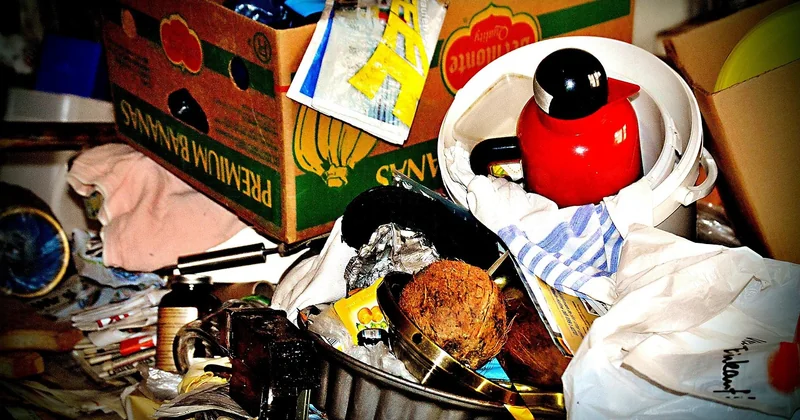
I use it constantly with my kids, usually in the ten minutes before dinner. Fifteen items per round, maybe three rounds on a Saturday morning, and a bedroom looks meaningfully different without a single dramatic purge session.
Why it works: most people stall on decluttering because the decision load is enormous. Limiting it to five per category turns an overwhelming judgment task into a short, finite one. My nine-year-old can do a full round unsupervised now.
Where the 5 5 5 rule fails
It doesn't touch sentimental clutter, and it won't solve deep storage problems. If your closet hasn't been emptied in four years, five items won't move the needle. Use it as maintenance, not as a rescue operation.
What are the four C's of decluttering?
The four C's of decluttering are clutter (identifying what's actually taking up space), categories (grouping like items together so you can see duplicates), containers (giving every category a defined home), and consistency (the maintenance habit that keeps it from returning).
Step three is where most people stop, and step four is where most people quit. That's the honest version.
Categories changed how I decluttered entirely. Before, I'd clean a drawer item by item. After, I'd pull every cable, every charger, every adapter in the house onto one table — and discovered we owned nineteen USB cables for a household with six devices. Seeing the pile was more persuasive than any amount of willpower.
Treat containers as limits, not storage
The container isn't there to hold everything. It's there to define the maximum. One bin for craft supplies means when the bin overflows, something leaves. That single reframe did more for long-term order in my house than any cleaning schedule.
Consistency is the hard part, and it's smaller than you think
Consistency doesn't mean daily effort. It means a recurring ten-minute check. Ours is Sunday evening, and it takes about a quarter of an hour. That's roughly thirteen hours a year to keep an entire household from drifting back into disorder.
How does a cluttered house affect a child?
A cluttered home tends to affect children through overstimulation and disrupted sleep, especially when the mess lives in shared spaces rather than their own room. Too much visual noise makes it harder to focus, harder to settle, and harder to keep track of belongings — which then feeds more chaos.
I watched this play out in my own house. During a six-week stretch when our living room doubled as a storage zone for renovation materials, both kids' bedtime routines stretched by roughly twenty minutes each night. Same bedtime, same routine, same parents. The only variable was the room. When the materials finally moved to the garage, bedtime snapped back within four days.
That's not a scientific study, and I won't pretend it is. But it matched what other parents have told me again and again: kids regulate better in spaces that feel calm.
What matters more than perfect tidiness
Predictability beats perfection. A slightly messy home with a reliable evening rhythm is better for a child than a spotless home with no rhythm at all. If you take one thing from this section, take that.
Comparing the tools you'll actually use
I've tried almost everything. Here's my honest assessment after cycling through all of these more than once.
| Tool | Best for | Weakness | My verdict |
|---|---|---|---|
| Shared digital calendar | Two working adults coordinating schedules | Kids under ten ignore it entirely | Keep it, but don't rely on it alone |
| Whiteboard on the fridge | Daily anchors and visible ownership | Gets ignored after a few weeks | Best for ages 6-14 |
| Chore app with points | Motivating older kids short-term | Novelty fades, maintenance is annoying | Skip it |
| Physical labeled bins | Containers and category limits | Requires an upfront clear-out | Non-negotiable in my house |
| Paper checklist | Adults building the habit first | Falls apart with more than two people | Good for the first month only |
The pattern I noticed: digital tools work for adults, physical visual tools work for kids, and nothing works if the ownership is unclear. The tool matters far less than who's responsible for noticing when it slips.
Getting kids involved without a nightly negotiation
Handing a seven-year-old a vague instruction like "tidy up" is a guaranteed failure. They need specifics, and they need them tied to an age-appropriate scope.

What worked in our house:
- Ages 3-5: put napkins out, place shoes on the rack, carry their plate to the counter.
- Ages 6-8: clear their own place setting, sort laundry into two piles, feed a pet.
- Ages 9-11: own one shared surface entirely, handle their own backpack and lunch box, fold their own clothes.
- Ages 12 and up: full ownership of their laundry, one weekly household task end to end, and a role in the Sunday check.
The negotiation stops when the expectation is fixed and visible. Ours lives on the fridge whiteboard, and "it's not on the board" has ended more arguments than I can count.
Splitting the mental load between adults
The most common failure I see in other families isn't the kids. It's one adult tracking everything while the other waits for instructions. That arrangement collapses eventually, usually around month two.
Our fix was to assign entire domains rather than individual jobs. One person owns the kitchen and meals. The other owns laundry and appointments. Neither person supervises the other. It's not perfectly even week to week, but over a month it roughly balances, and nobody is carrying the whole invisible list alone.
What I'd do differently if I started over
I'd skip the elaborate planning phase entirely. Two years of iteration taught me that the plan was never the bottleneck — starting was.
I'd begin with a single anchor. Just dinner reset, nothing else, for three weeks. Then add the entryway. Then the morning. Slow stacking beats a comprehensive system that collapses in eleven days.
And I'd accept that some weeks the house looks terrible. Not because the routine failed, but because life has seasons, and a system that can't bend without breaking isn't a system at all — it's a deadline.
The routine that keeps your home organized is almost certainly smaller than whatever you're imagining right now. Fewer rules, fewer locations, fewer people involved at the start. Four anchors and ten honest minutes. If your house is still standing after a month, you're doing it right.